Simulation Success
Reality Success
FOVI-Dex
Loading figures and recordings.
 FOVI-Dex
Foveation enables efficient perceptive learning
of dexterous manipulation in simulation
No human demonstrations. No state-based policy pretraining or distillation.
Learn in simulation. Transfer zero-shot to the real robot.
Dex Manipulation Workshop · CoRL 202610th Conference on Robot Learning (CoRL 2026), Austin TX, USA.
Rendering and encoding dense images consume resources that could support more parallel learning. Foveation concentrates detail around gaze in a compact image while retaining peripheral context.
Drag on the left image to move gaze. The left raster matches the high-resolution model; the active view samples the full source image. This illustrates camera sampling on a static simulation scene. Training renders each observation directly.
Throughput: full training runs on eight L40S GPUs, averaged over three seeds. Environment allocations use the same approximate 45 GB process-memory budget from single-Blackwell calibration.
Foveated observations preserve detail where the robot looks, while leaving more compute for parallel learning. Compare the models on five-object clutter over the same 72 hours of training.
Moving gaze · nonuniform detail
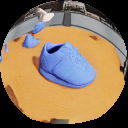
Concentrate detail at fixation, with wide peripheral context.
Moving gaze · uniform detail
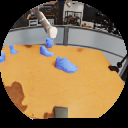
The same compact image budget, spread uniformly across the view.
Fixed gaze · uniform detail
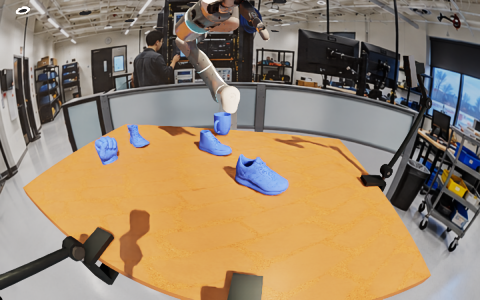
A dense view of the whole scene, at a larger rendering and encoding cost.
78%
The policy must distinguish a boot, laced boot, and sneaker among clutter, then grasp the requested object. It transfers directly from simulation, without real-world policy fine-tuning.

Per model: 2,000 simulation trials and 50 reviewed robot trials. “Sim (50)” uses the same planned layouts and targets as the robot trials and is a subset of the full simulation set. These are trial-success rates from one completed checkpoint per model, distinct from the training curves above.
Ten foveated-policy layouts, with two trials per target and 8/10 robot successes. Simulations are fresh deployment reruns that stop on success, failure, or the time limit; they are separate from the scored benchmark above. Clips keep their native timing; the shorter clip holds its final frame.
We vary how strongly the image concentrates detail around gaze while keeping the compact image size, encoder, and training allocation fixed.
Intermediate foveation outperforms both the strongest concentration and nearly uniform sampling. The main model sits in this effective region; overlapping seed ranges do not establish a precise optimum.
Stronger foveationNearly uniform

Five-object training on four GPUs, compared over the same 72 hours. Each seed contributes its best recorded success-region occupancy (ISR) at the final curriculum level. ISR measures time in the success region, not episode success.
We use OmniLensDistortionLutAPI to attach forward and inverse lookup textures to the RTX camera. RTX traces rays directly into a compact foveated image. Gaze moves the high-detail center while retaining the wider scene. On the robot, software samples the same view from a fixed fisheye camera.
A frozen, foveation-adapted visual encoder feeds a recurrent policy alongside the instruction, tactile feedback, and robot state. Reinforcement learning trains the motor policy, with supervised gaze learning and a privileged critic used only during training.
Tracing starts with a pixel and asks where it looks. Operations such as motion-vector computation ask the reverse: where does this direction land in the image?
We analytically invert the angular mapping and CMF warp, then sample that inverse into a second texture. Its square domain is an octahedral encoding of directions over the whole sphere. Its two stored values are the corresponding forward-texture coordinates.
Try it Move gaze: the rendered scene changes, but both lookup textures and this camera-space correspondence remain fixed. Switch to uniform sampling: both maps change together.
Interactive WebGL illustration of the captured five-object scene, Rizon arm and Sharpa hand. Joint positions and camera calibration match the film’s RTX capture; this browser view uses lit meshes and a cube-camera ray lookup, following the Alpha/NIST viewer. It omits the lab background; the film shows native RTX output.
NVIDIA
Read the paper ↗